 by
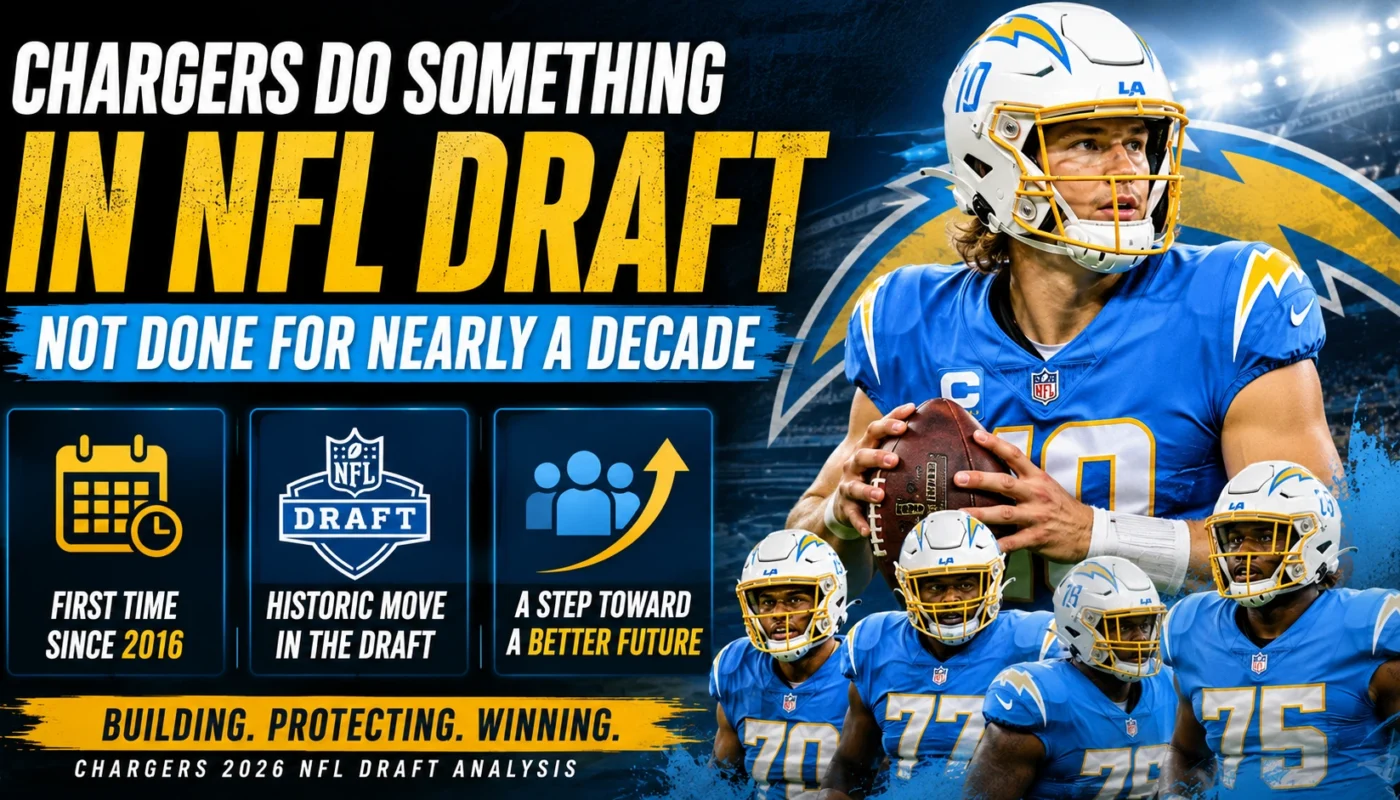
by The Los Angeles Chargers entered the spring of 2026 with a clear, singular mission: protect the franchise. After a 2025 season plagued by an astounding 29 different starting offensive line combinations and a disappointing early playoff exit, the front office realized that Justin Herbert’s generational talent was being neutralized by a lack of stability upfront. By analyzing the Chargers 2026 NFL draft strategy Justin Herbert offensive line rebuild analysis, it becomes evident that Jim Harbaugh and GM Joe Hortiz have finally shifted away from the “fresh start” rhetoric and moved into a phase of structural reinforcement.
The Philosophical Pivot: From Roman to McDaniel
The firing of longtime offensive coordinator Greg Roman in January 2026 signaled the end of the “ground-and-pound” identity that had become too predictable for AFC West rivals. Replacing him with former Dolphins head coach Mike McDaniel brought a more dynamic, zone-blocking scheme designed to get the ball out of Herbert’s hands quickly and efficiently. Central to the Chargers 2026 NFL draft strategy Justin Herbert offensive line rebuild analysis is this schematic shift; McDaniel’s system requires agile, intelligent linemen who can move in space, a stark contrast to the massive, stationary blockers favored by previous regimes.
Round 2: The Jake Slaughter Selection
While Miami edge rusher Akheem Mesidor was the flashy first-round choice at No. 22, the real “win” for Herbert’s longevity came in the second round with the selection of Florida center Jake Slaughter. Experts conducting a Chargers 2026 NFL draft strategy Justin Herbert offensive line rebuild analysis point to Slaughter as the “missing link” for the interior. Though drafted as a center—ranked No. 1 at the position by Next Gen Stats—the Chargers project him to start immediately at right guard to provide veteran-level pass protection alongside Joe Alt.
Strengthening the Depth: Day 3’s Offensive Influx
The Chargers didn’t just stop at the top of the draft; they spent four of their eight total picks on the offensive line to ensure that a single injury wouldn’t derail their season again. Looking at the Chargers 2026 NFL draft strategy Justin Herbert offensive line rebuild analysis, the Day 3 additions of Travis Burke (Memphis), Logan Taylor (Boston College), and Alex Harkey (Oregon) provide a necessary insurance policy. These players weren’t just “best player available” picks; they were hand-selected for their versatility, with Logan Taylor having played almost every position on the line during his collegiate career.
2026 Chargers Offensive Line Depth Chart (Post-Draft)
| Position | Starter | Key Depth / Rookie |
| Left Tackle | Rashawn Slater | Travis Burke (R) |
| Left Guard | Cole Strange | Trevor Penning |
| Center | Tyler Biadasz | Logan Taylor (R) |
| Right Guard | Jake Slaughter (R) | Kayode Awosika |
| Right Tackle | Joe Alt | Trey Pipkins III |
The “Harbaugh Effect” in the Trenches
Jim Harbaugh’s return to the NFL has been defined by a “toughness first” mentality, and he has consistently stated that games are won and lost in the trenches. This Chargers 2026 NFL draft strategy Justin Herbert offensive line rebuild analysis suggests that Harbaugh is building the 2026 roster to mirror his successful Michigan and 49ers teams. By pairing elite tackles like Slater and Alt with a revamped interior, Harbaugh is creating a “fortress” around Herbert that should theoretically reduce the number of hits the quarterback takes by at least 20% compared to last season.
How the Rebuild Unlocks the Deep Ball
With better protection comes the ability to let routes develop further downfield, which plays directly into Justin Herbert’s elite arm strength. An in-depth Chargers 2026 NFL draft strategy Justin Herbert offensive line rebuild analysis reveals that the addition of vertical speedster Brenen Thompson in the draft only works if the line can hold for four seconds. Last year, Herbert often had to settle for check-downs because the pocket collapsed instantly; in 2026, the upgraded line should allow the Chargers to reclaim their status as one of the most explosive air attacks in the league.
The Role of Free Agency Synergy
The draft picks didn’t happen in a vacuum; they were designed to complement the veteran signings of Tyler Biadasz and Cole Strange. When performing a Chargers 2026 NFL draft strategy Justin Herbert offensive line rebuild analysis, it’s clear the team wanted to avoid starting five rookies. Instead, they built a “sandwich” of experience, placing rookie Jake Slaughter between veteran center Biadasz and superstar tackle Joe Alt. This blend of youth and experience is designed to minimize the communication errors that led to so many unblocked rushers in 2025.
Managing the Cap and the Future
Joe Hortiz has managed to rebuild the line without mortgaging the future, leaving enough cap space to handle upcoming extensions for Tuli Tuipulotu and Derwin James. The Chargers 2026 NFL draft strategy Justin Herbert offensive line rebuild analysis shows a front office that is finally being fiscally responsible while remaining aggressive. By hitting on mid-round picks like Logan Taylor, the Chargers have secured cheap, talented depth for the next four years, allowing them to spend their free-agent dollars on high-impact skill players in the 2027 cycle.
Impact on the Run Game: The Zone Scheme
Under Mike McDaniel, the run game will look vastly different, favoring a wide-zone scheme that rewards speed and lateral movement. This Chargers 2026 NFL draft strategy Justin Herbert offensive line rebuild analysis notes that players like Travis Burke were drafted specifically for their “reach-block” capabilities. If the line can successfully seal the edges, running backs like Omarion Hampton will have massive lanes, forcing defenses to pull safeties into the box and leaving Herbert with one-on-one matchups on the outside.
Fantasy Football: The Herbert Renaissance
For fantasy managers, the Chargers 2026 NFL draft strategy Justin Herbert offensive line rebuild analysis is a massive “Buy” signal for the entire LA offense. A protected Herbert is a Top-5 fantasy quarterback, and a stable offensive line raises the floor for everyone from Ladd McConkey to the tight end room. If you are drafting for the 2026 season, don’t overlook the “unseen” value that these offensive line picks provide to the Chargers’ scoring potential.
Conclusion: A New Foundation in Los Angeles
The 2026 offseason will likely be remembered as the moment the Chargers finally stopped talking about “protecting Herbert” and actually did it. The Chargers 2026 NFL draft strategy Justin Herbert offensive line rebuild analysis paints a picture of an organization that has aligned its coaching, scouting, and management toward a single goal. With a reinforced line, a new offensive genius in the headset, and a healthy franchise QB, the Chargers have finally built a foundation that can sustain a deep playoff run.
Frequently Asked Questions
Q: Who will be the starting right guard for the Chargers in 2026?
A: Current projections following the Chargers 2026 NFL draft strategy Justin Herbert offensive line rebuild analysis suggest that second-round pick Jake Slaughter will start at guard, even though he may move to center in future years.
Q: Did the Chargers address their defense in the draft?
A: Yes, while the offense was a major focus, they used their first-round pick on edge rusher Akheem Mesidor and added safety depth with Genesis Smith.
Q: How does Mike McDaniel’s system differ from Greg Roman’s?
A: McDaniel utilizes a “West Coast” zone-blocking system that prioritizes speed and quick passes, whereas Roman’s system was a heavy, power-run-based scheme that often required Herbert to hold the ball longer.