 by
by Watching an NFL game for the first time can feel like trying to solve a complex puzzle while 22 giant athletes move at lightning speed. To truly enjoy the strategy behind the “gridiron,” you need NFL positions explained for beginners with roles and responsibilities to make sense of the chaos. In professional football, every player has a highly specialized job, and understanding these individual duties is the secret to moving from a casual observer to a savvy fan who can predict the next big play.
The Quarterback: The On-Field General
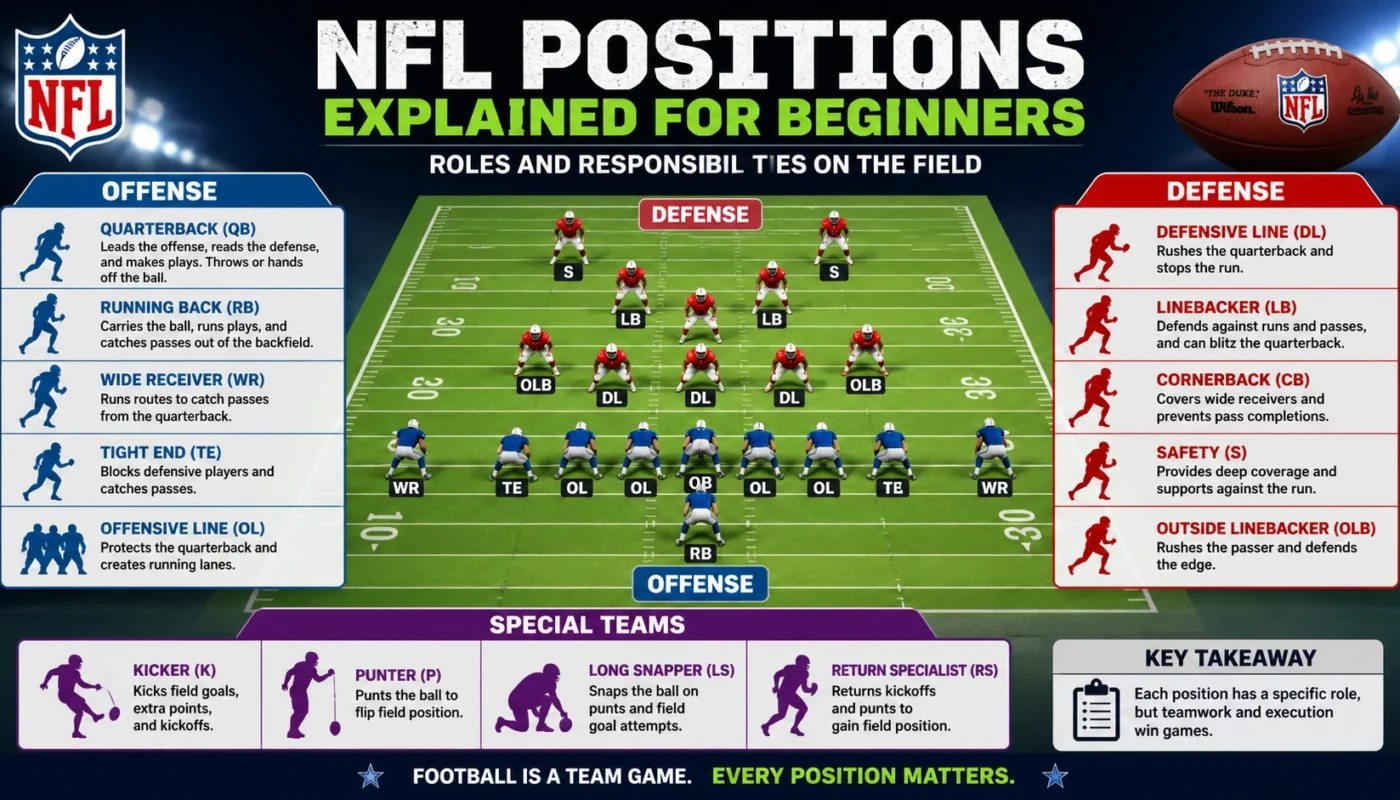
At the heart of every offensive unit is the Quarterback (QB), the player who touches the ball on almost every play and serves as the primary leader. When looking at NFL positions explained for beginners with roles and responsibilities, the QB is essentially the “on-field coach” who relays plays from the sideline to the huddle and adjusts the strategy at the line of scrimmage based on the defense. Their main job is to either hand the ball off to a runner or throw a precise pass to a receiver downfield.
The Backfield: Power and Speed
Behind or beside the quarterback, you will find the Running Backs, who are the workhorses of the ground game. These NFL positions explained for beginners with roles and responsibilities include the Halfback (the primary runner) and the Fullback (a powerful blocker). While the Halfback uses speed and agility to find gaps in the defense, the Fullback acts as a human battering ram, clearing a path for the ball carrier or protecting the quarterback during passing plays.
The Wide Receivers: The Deep Threats
Wide Receivers (WR) are the track stars of the football field, lining up near the sidelines to stretch the defense vertically. Any guide to NFL positions explained for beginners with roles and responsibilities must highlight their incredible hand-eye coordination and breakaway speed. Their primary goal is to run specific “routes”—pre-planned running paths—to get open and catch passes from the quarterback for large gains or touchdowns.
The Tight End: The Ultimate Hybrid
The Tight End (TE) is perhaps the most versatile role on the entire field, serving as a bridge between the offensive line and the receivers. In the context of NFL positions explained for beginners with roles and responsibilities, a Tight End must be large enough to block massive defensive linemen yet agile enough to catch passes in the middle of the field. This “dual-threat” capability makes them a nightmare for defensive coordinators to cover.
The Offensive Line: The Unsung Heroes
The “Big Men” upfront are the Offensive Linemen, a five-man wall consisting of a Center, two Guards, and two Tackles. In terms of NFL positions explained for beginners with roles and responsibilities, these players are the only ones on offense who rarely touch the ball; instead, they focus on “pass protection” to keep the QB safe or “run blocking” to push defenders out of the way. The Center has the unique job of “snapping” the ball between their legs to start the play. Ft
| Position | Primary Goal | Key Physical Attribute |
| Quarterback | Distribute the ball & lead | Intelligence & Arm Strength |
| Running Back | Carry the ball for yardage | Agility & Balance |
| Wide Receiver | Catch long passes | Speed & Catching Ability |
| Offensive Line | Protect and block | Massive Size & Strength |
The Defensive Line: The First Wall
Switching to the other side of the ball, the Defensive Line (DL) is tasked with disrupting the offense at the very start of the play. When studying NFL positions explained for beginners with roles and responsibilities, you’ll see Defensive Tackles and Defensive Ends trying to “sack” the quarterback or tackle the runner before they reach the line of scrimmage. Their goal is pure disruption, using brute force and specialized hand techniques to overpower the offensive blockers.
The Linebackers: The Defensive Quarterbacks
Lining up just behind the defensive line are the Linebackers (LB), who are often considered the most well-rounded athletes on defense. These NFL positions explained for beginners with roles and responsibilities involve a mix of stopping the run, “blitzing” (rushing the QB), and dropping back into coverage to stop passes. The Middle Linebacker (MLB) usually calls the defensive plays and ensures everyone is in the correct position before the snap.
The Secondary: The Last Line of Defense
The Secondary consists of Cornerbacks and Safeties, whose main job is to prevent the offense from completing long passes. In the breakdown of NFL positions explained for beginners with roles and responsibilities, Cornerbacks usually “shadow” the Wide Receivers one-on-one, while Safeties act as the “center fielders” of the defense, staying deep to provide help wherever a ball is thrown. If a pass gets past the safeties, it almost certainly results in a touchdown.
Special Teams: The Game Changers
While they aren’t on the field for every play, Special Teams units handle critical moments like kickoffs, punts, and field goals. These NFL positions explained for beginners with roles and responsibilities include the Kicker (for scoring points) and the Punter (for kicking the ball away to flip field position). A single blocked punt or a long kickoff return can completely change the momentum of a game in seconds.
How the Positions Work Together
Football is a game of 11-on-11 chess, and knowing NFL positions explained for beginners with roles and responsibilities helps you see how the pieces move in harmony. For an offensive play to work, the linemen must block, the receivers must run the right routes, and the quarterback must make a split-second decision. On defense, the line pressures the QB so the secondary has less time to cover their targets. It is the ultimate team sport where one person’s failure can ruin the entire play.
Understanding Formations and Strategies
Once you grasp NFL positions explained for beginners with roles and responsibilities, you’ll start to notice different formations, like the “Shotgun” or “I-Formation.” Coaches move players around to create mismatches—for example, putting a fast running back against a slower linebacker. Learning these nuances is the next step in becoming a football expert and enjoying the high-level strategy that makes the NFL the most popular league in the United States.
Why Player Size Varies So Much
You might notice that a 190-pound Wide Receiver looks tiny next to a 320-pound Offensive Tackle. This is because NFL positions explained for beginners with roles and responsibilities are based on specific physical demands. A tackle needs mass to hold their ground, while a receiver needs a lean build for maximum speed. This physical diversity is what allows so many different types of athletes to find a home on a professional football roster.
The Importance of the “Trenches”
Most fans watch the ball, but seasoned viewers watch the “trenches”—the battle between the offensive and defensive lines. In the world of NFL positions explained for beginners with roles and responsibilities, if a team cannot win in the trenches, they cannot win the game. If the offensive line collapses, the quarterback can’t throw; if the defensive line is pushed back, the opponent will run for easy yards all day.
Key Vocabulary for New Fans
To master the concepts of NFL positions explained for beginners with roles and responsibilities, you should learn a few key terms. An “Interception” is when a defensive player catches a pass meant for the offense. A “Sack” is when the defense tackles the quarterback behind the line. A “Fumble” occurs when a player drops the ball while it’s still in play. Knowing these terms makes following the commentary much easier.
How to Watch Your First Full Game
Now that you have NFL positions explained for beginners with roles and responsibilities, try watching a game and focusing on just one position group for a few plays. Watch how the offensive tackles move their feet, or follow a single cornerback as he tries to keep up with a receiver. You will quickly realize how much “game within the game” is happening away from the football itself.
Conclusion: Mastering the Gridiron
Learning the ropes doesn’t happen overnight, but having NFL positions explained for beginners with roles and responsibilities gives you the foundation you need to follow any broadcast. From the leadership of the Quarterback to the precision of the Kicker, every role is a vital gear in a massive machine. Next time you sit down on a Sunday afternoon, you won’t just see a pile of players—you’ll see a strategic battle unfolding right before your eyes.
References
- DICK’S Sporting Goods. (n.d.). Football Positions & What They Do. PRO TIPS. https://www.dickssportinggoods.com/protips/sports-and-activities/football/football-101-football-positions-and-their-roles
- Fubo News. (2023, June 26). A Beginner’s Guide to Football Positions and What They Do. https://www.fubo.tv/news/nfl/beginners-guide-football-positions-what-they-do-fubo-nfl-college-free-live-streams/
- NFL FLAG. (n.d.). Flag Football Positions – NFL FLAG. https://nflflag.com/flag-football-rules/football-positions
- Red Bull. (2025, August 29). American football positions explained: Offense, defense and special teams. https://www.redbull.com/int-en/american-football-positions-explained